
Criminal Cases in the Oneida County Courts
The Oneida County Clerk of Circuit Court keeps the county's felony, misdemeanor, and criminal-traffic files. Wisconsin Circuit Court Branch I and Branch II sit in the courthouse at 1 South Oneida Avenue in Rhinelander. Each branch may hear assigned felony and misdemeanor matters. The clerk's third-floor counter is the place to request a full file, a plain copy, or a certified court document. The District Attorney files and prosecutes state charges, but the clerk remains the custodian of the court record.
Wisconsin case numbers identify the filing year, case type, and sequence. In WCCA, CF marks a criminal felony case, CM a criminal misdemeanor case, and CT a criminal-traffic case. TR and FO entries may concern traffic or forfeiture matters that are not criminal convictions. A Rhinelander ordinance citation may also remain a city matter rather than become a Oneida County criminal court case. Read the case type and charge statute instead of relying on the conduct described in a citation.
Oneida County Criminal Court Branches
Branch I is reached at 715-369-6157, while Branch II is reached at 715-369-6200. The main clerk number is 715-369-6120. Court files, copies, payments, and certification requests run through the clerk rather than a judge's office. The clerk page identifies a deputy clerk for criminal matters, which helps route a request that names the exact Oneida County criminal case and document.
Both branches share the courthouse address and the clerk's weekday hours of 8:00 a.m. to 4:30 p.m. Security, device, parking, accessibility, and recording details were not verified on a current official visitor page. Call the clerk before a trip that depends on any of those conditions. That check is especially useful when the desired Oneida County case is archived, confidential, or available only in paper form.
How to Search Case Records
Wisconsin Circuit Court Access, commonly called WCCA or CCAP, is the free statewide index for Oneida County criminal court cases. Users must accept its notice. WCCA warns that it is not a criminal-history report and that a name match does not prove identity. A case number is the best key. For a name search, add the first name, middle name, filing years, and Oneida County filter to reduce false matches.
- Accept the WCCA notice and choose a party-name or case-number search.
- Select Oneida County, then enter the known name or exact case number.
- Narrow results with CF, CM, or CT and a filing-date range.
- Open the docket and read each charge, plea, event, disposition, and sentence.
- Give the clerk the case number and document name when ordering a complete or certified copy.
These are the actual WCCA search fields documented for Oneida County case research:
| Field Label | Type | Required | Notes |
|---|---|---|---|
| Case number | Text | No | Direct Wisconsin county/year/type/sequence search |
| Last name | Text | Conditional | Spelling controls party results |
| First and middle name | Text | No | Narrows common names |
| Birth date | Date | No | Identity aid; public display may be limited |
| County | Dropdown | No | Select Oneida for local cases |
| Case type | Dropdown | No | Use CF, CM, and CT for criminal files |
| Filing date range | Date fields | No | Narrows the years searched |
Oneida County WCCA Case Limits
WCCA is an event index, not every page of the clerk's file. Its entries may list a complaint, initial appearance, bail hearing, preliminary hearing, information, arraignment, motion, pretrial conference, plea hearing, trial, sentencing, warrant action, or payment. Some documents are available only through the clerk or to eFiling parties. Juvenile, sealed, expunged, and other confidential matters may be absent or restricted.
A missing PDF does not mean a hearing or filing did not occur. Record the event name and document number, then ask the Oneida County clerk whether the item is remote, paper, archived, or confidential. Request the current plain-copy or certified-copy cost before ordering. Wisconsin's statewide fee schedule governs many court charges, but the research did not establish a local fee for every document.
The clerk's local traffic and ordinance guidance illustrates how defaults, payments, and warrant-related events can affect a docket.
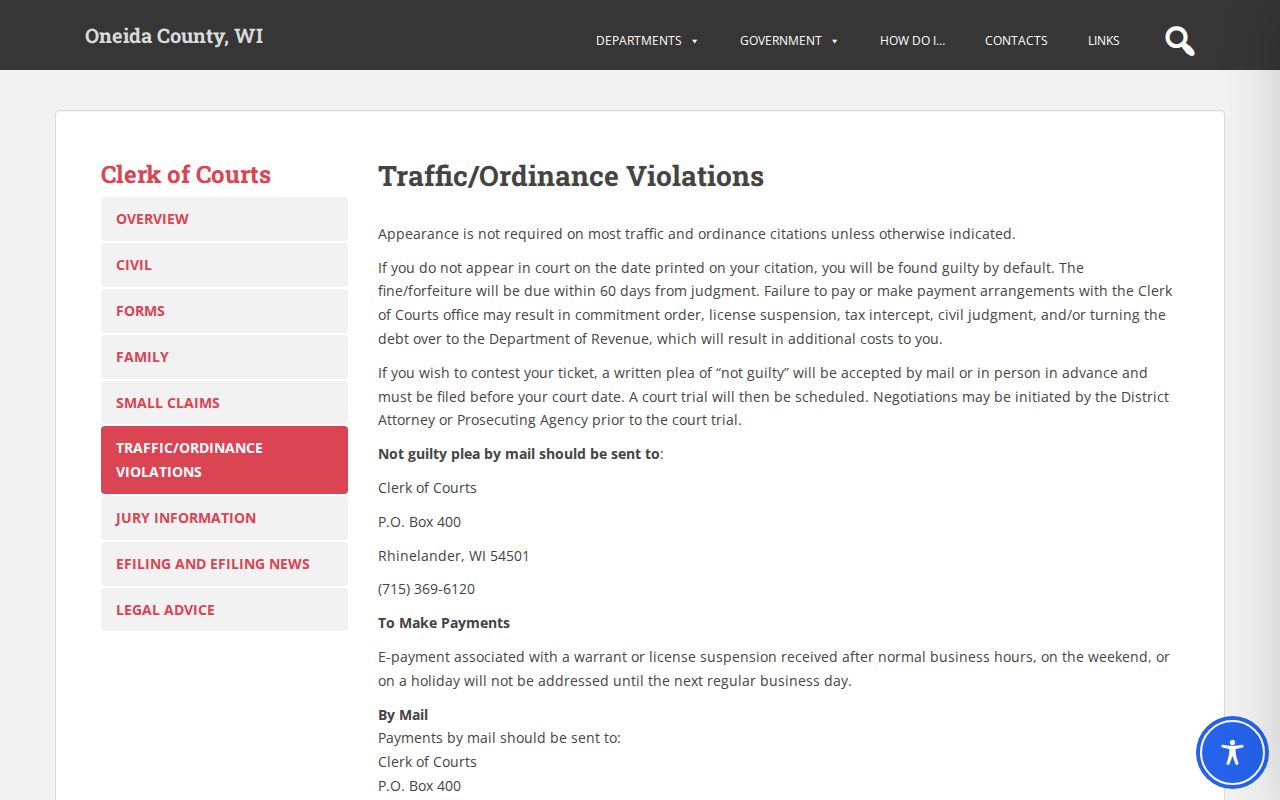
The page reinforces that an online payment or docket entry should be checked against the court's current status, especially after hours.
What the Case File Shows
A Oneida County criminal case file follows the prosecution, not just the person. It can show the assigned branch and judge, prosecutor, defense counsel, allegations in the complaint, formal felony information, motions, pleas, findings, and the result for each count. Financial entries may include court obligations, balance, and receivables. The public event list can also show hearing dates and warrant events, though it is not the full paper file.
| Case identity | County, case number, caption, filing date, type, status, branch, and assigned judge |
|---|---|
| Parties and counsel | Defendant, prosecutor, defense counsel, and public identity fields where permitted |
| Charges | Count number, statute, offense description, severity, alleged date, and plea |
| Docket events | Filings, appearances, hearings, motions, warrants, trial events, and satisfaction entries |
| Disposition | Outcome and date for each count, including conviction, dismissal, or acquittal |
| Sentence | Judgment, confinement, probation or supervision terms, restitution, and bond conditions where public |
Compare counts one by one. One charge can be dismissed while another ends in conviction. A pending allegation is not a finding of guilt, and a case caption alone cannot reveal the outcome.
Reading Oneida County Criminal Charges
Three result terms matter in Oneida County court records. A dismissal ends a count without conviction on that count. An acquittal is a not-guilty result after adjudication. A conviction is a judgment of guilt after a plea or verdict. A no-contest plea followed by judgment is still a conviction, even when the court stays confinement and orders probation.
- Complaint
- The prosecutor's sworn charging allegations.
- Information
- The formal felony charging document filed after preliminary-hearing procedure or waiver.
- Disposition
- The outcome assigned to an individual count.
- Judgment of conviction
- The formal court record of guilt and sentence.
- Extended supervision
- The community portion of a Wisconsin truth-in-sentencing term after confinement.
Booking allegations and prosecutor-filed counts may differ. For the broader distinction among jail, court, and state repository records, the Oneida County criminal history overview routes each record to its custodian.
Stages of a Criminal Case
Wisconsin criminal procedure can include arrest or citation, initial appearance, a release or bond decision, complaint, and then pretrial work. A felony adds a preliminary hearing or waiver and an information before arraignment. Motions and negotiations may lead to a plea, while unresolved charges can go to trial. Judgment and sentence follow a conviction. Postconviction motions or an appeal may create later entries.
Case flow: Charges Filed → Arraignment → Pretrial → Plea or Trial → Disposition → Sentencing
The flow is a reading order, not a promise that every case uses every stage. Diversion, dismissal, waiver, a missed appearance, or a warrant can change the path. The Oneida County Criminal Justice Coordinating Committee also advertises diversion, and official program material identifies a Rhinelander/Oneida County OWI Court with a minimum one-year program. Those conditions can create docket events beyond a simple plea-and-sentence sequence.
Oneida County Criminal eFiling Stamps
Oneida County requires eFiling for CF, CM, and CT cases. The clerk's eFiling page explains that an electronic court document carries a court official's signature in a three-inch top margin. The generated header also bears the file stamp, case number, document number, filed date, and pagination. Those fields help readers match a downloaded document to the right Oneida County criminal docket.
The official Oneida County eFiling page shows the local criminal case types and document-header rules.
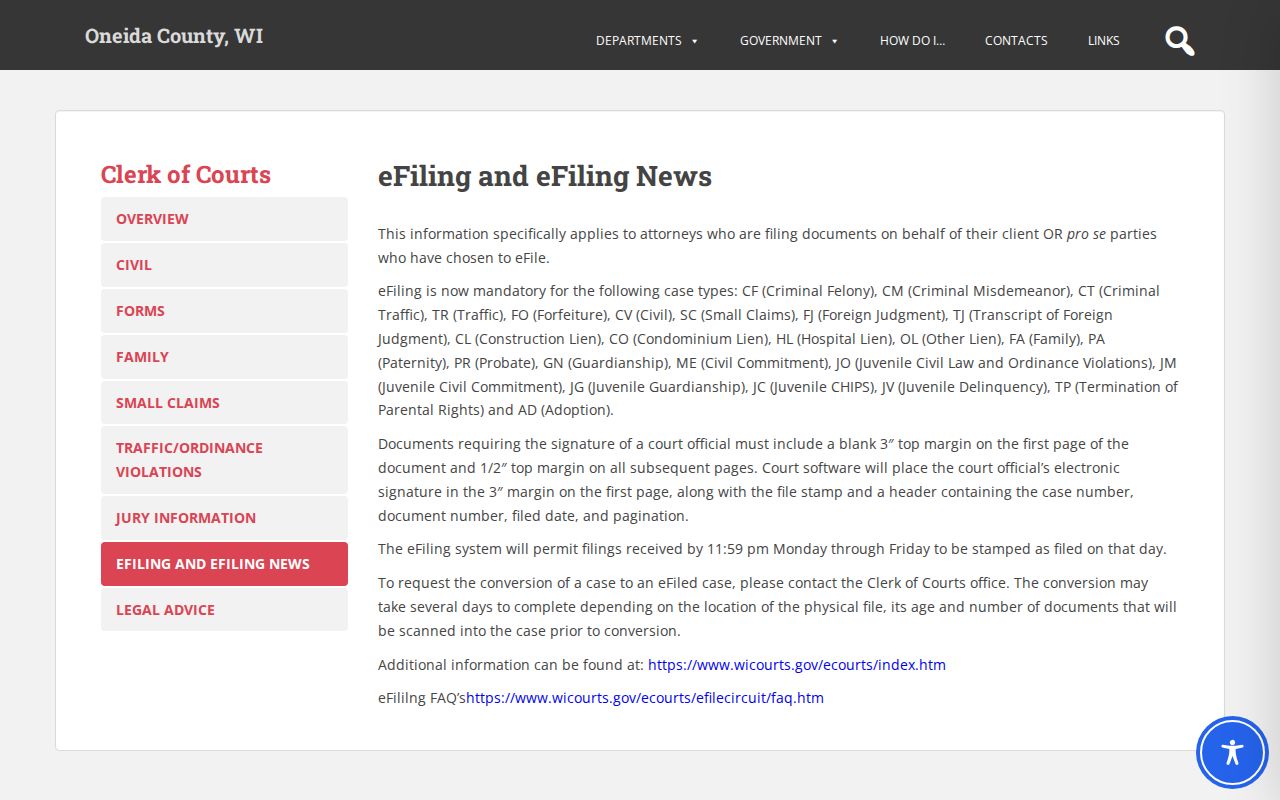
The image supports a practical check: compare its displayed filing metadata with the case number and event entry in WCCA.
A filing received by 11:59 p.m. Monday through Friday can receive that day's stamp. That rule concerns the official filing date, not the moment the document becomes visible to every public user.
Access & Restrictions
Wisconsin law begins with a broad presumption of access, but not every part of a criminal case is public. Wis. Stat. § 19.31 states the access policy, while § 19.35 addresses inspection, copies, and fees. Juvenile files, victim-sensitive data, medical facts, confidential identifiers, sealed matters, and security information can be withheld or redacted.
Wisconsin expungement under Wis. Stat. § 973.015 is limited and generally must be ordered at sentencing. An expunged court file normally disappears from ordinary WCCA access, but that does not mean every police, jail, or DOJ record vanishes. When a case is missing, ask the clerk whether it is confidential, archived, or expunged without demanding protected details.
The Western District of Wisconsin court site marks the separate federal access layer beyond WCCA.
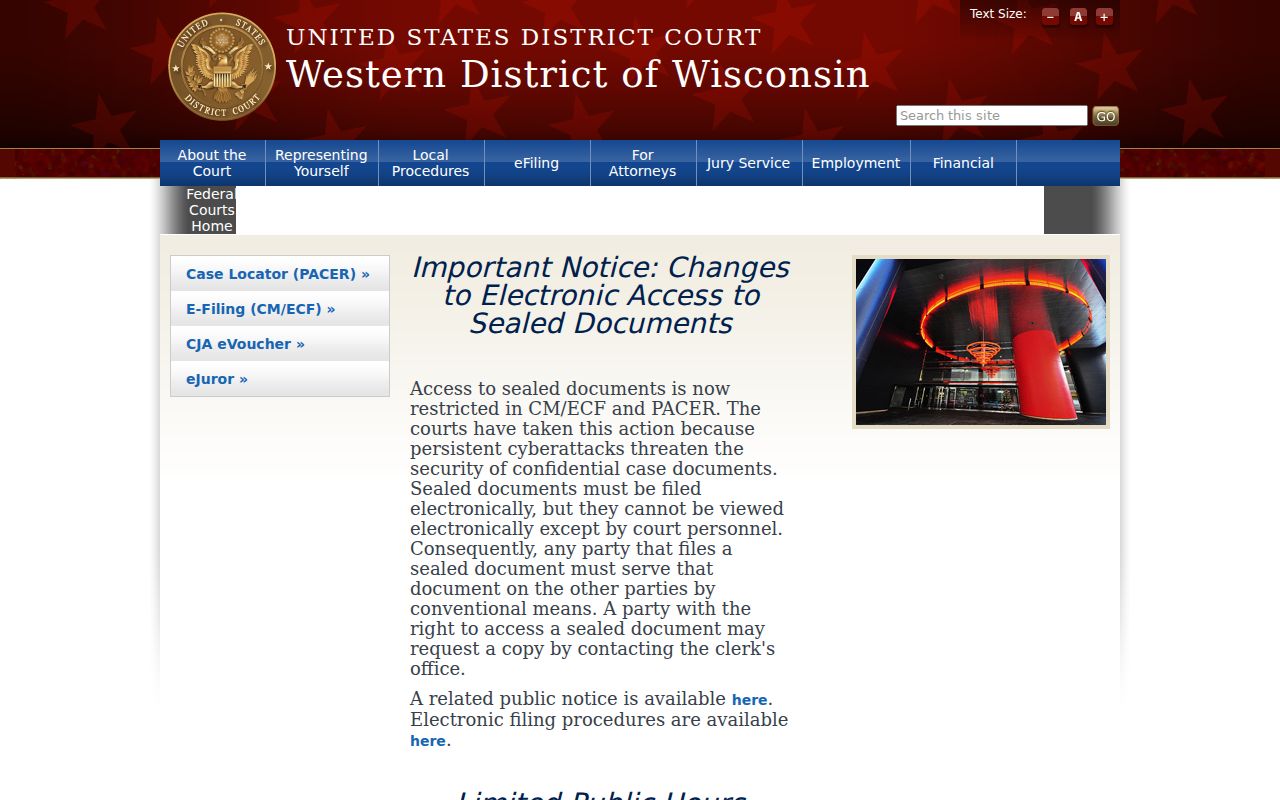
This source image is from the Western District court site and marks the separate federal layer discussed next.
Federal Criminal Cases Beyond Oneida County
Federal prosecutions do not appear as complete cases in WCCA. Oneida County lies in the U.S. District Court for the Western District of Wisconsin. A reader who knows the matter is federal should use that court and PACER instead of assuming the county clerk holds the docket. Registration and the current federal fee schedule apply to PACER document access.
The official PACER service shows the federal court record access point.
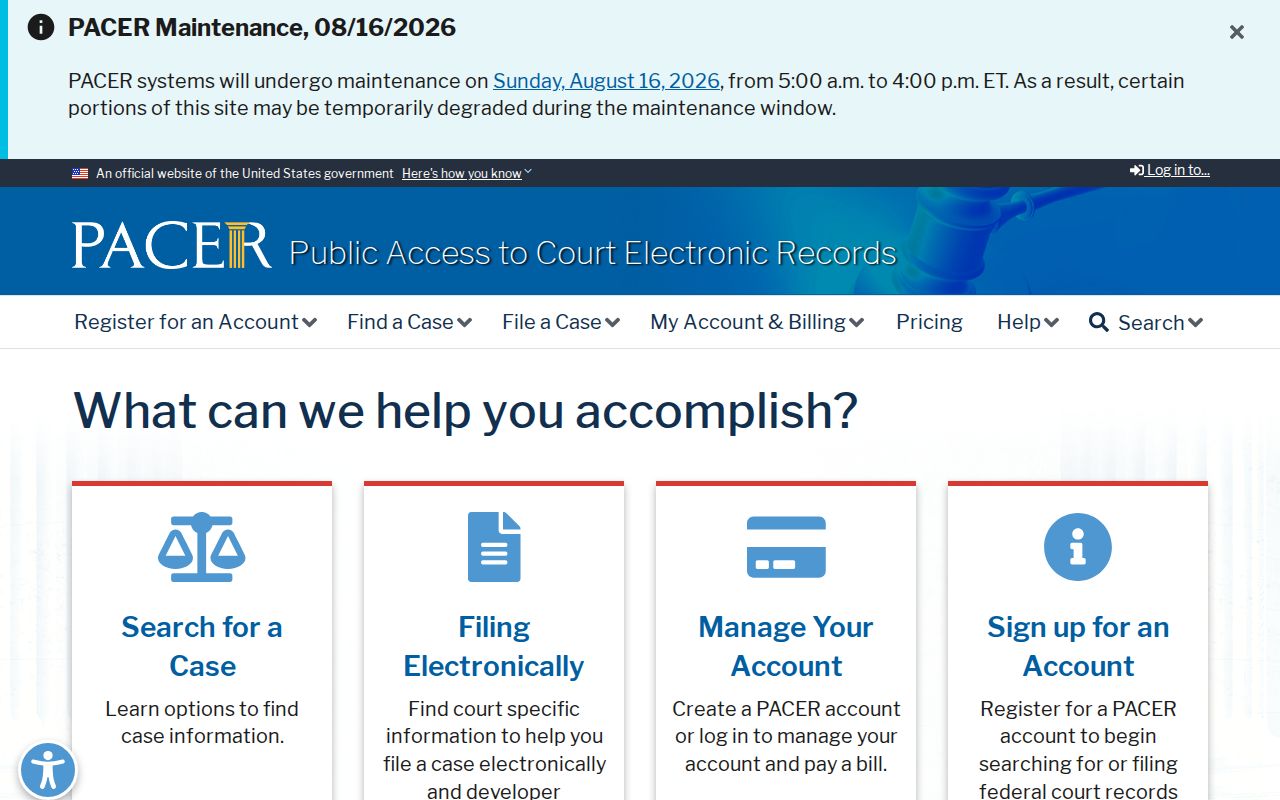
PACER is authoritative for its federal docket, while the Oneida County clerk remains authoritative for the local Wisconsin Circuit Court file.
A person held in the county on federal process may not yet appear as a designated federal prisoner. Court custody, jail custody, and the federal docket are distinct records, so follow the agency and court named in the case rather than the location alone.